
Blog Details
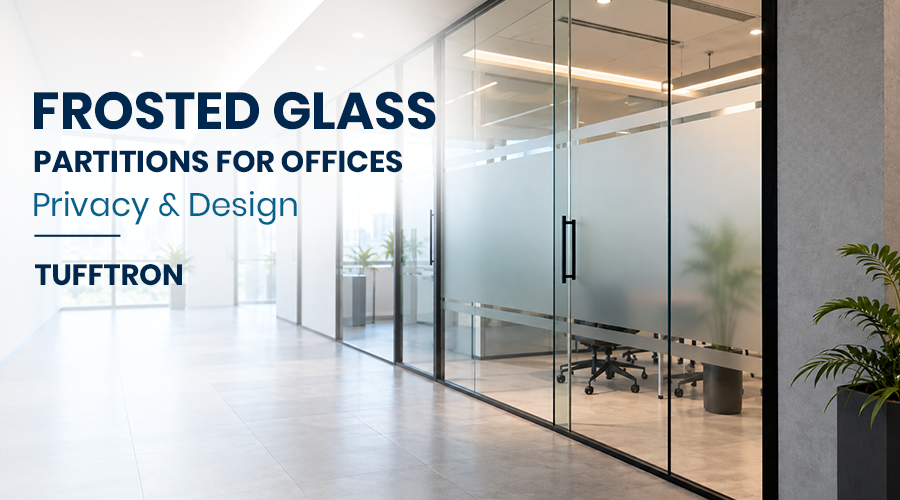
Frosted Glass Partitions for Offices: Privacy and Design Options for Modern Workspaces
An office can have plenty of glass and still feel private. The trick is deciding where people need to see through and where they don't.
Frosted glass is useful for meeting rooms, cabins and other areas where you want to block a clear view without putting up a solid wall. It still lets light through, so the space does not feel completely closed.
The choice is not only about how the glass looks. The level of frosting, the pattern, the size of the panels and the type of glass underneath all matter when planning an office partition.
Table of Contents
- Why Use Frosted Glass in an Office?
- What Does Frosted Glass Actually Do?
- Frosted Glass Partition Options for Offices
- Where Do Frosted Partitions Work Best?
- Does Frosted Glass Make a Partition Private?
- Frosted Glass and Toughened Glass Are Not the Same Thing
- What Should You Check Before Choosing a Partition?
- Frosted Glass Partitions in Andhra Pradesh and Guntur
- Final Thoughts
- FAQs
Why Use Frosted Glass in an Office?
A completely open office looks good when everything is new and nobody is having a private meeting.
Then the practical problems start.
A manager needs to speak to an employee. Someone has a client meeting. HR is discussing something confidential. People sitting outside can see exactly what is happening inside the cabin.
A solid wall solves the privacy problem, but it also blocks light and makes the office feel more divided.
Frosted glass sits somewhere in between.
It will separate the space without making it feel like a closed room. Light can still pass through the glass, while the frosted surface makes it difficult to see clearly through the panel.
That is one reason frosted glass partitions in Andhra Pradesh are being considered for offices, commercial spaces and other workplaces where both privacy and an open layout matter.
What Does Frosted Glass Actually Do?
Frosted glass is made by treating the surface of clear glass so that light passing through it gets scattered. The result is a translucent surface rather than a completely transparent one.
You can still get light through it. You just cannot see a clear image on the other side.
That difference is useful in an office.
A person sitting inside a meeting room may still see that someone is standing outside, but they won't have the same clear view they would have through normal clear glass.
Tufftron produces frosted glass using processes such as sandblasting and acid etching, and its frosted glass is used for partitions and other residential and commercial applications.
Frosted Glass Partition Options for Offices
Frosting does not have to cover the entire glass panel.
Full Frosted Glass
The whole panel is frosted when more visual privacy is required.
This works well for meeting rooms, cabins and areas where people do not need a clear view through the glass.
Partial Frosting
Only part of the glass is frosted.
For example, the lower portion of a partition can be frosted while the upper portion remains clear. This gives some privacy without completely blocking visibility.
Frosted Bands
A horizontal frosted section can be added to a clear panel.
This is a simple option when the main concern is blocking direct eye-level views rather than making the whole room private.
Frosted Patterns and Designs
Frosting can also be used to create patterns, lines or shapes instead of covering the entire panel.
Company logos can be incorporated into some designs as well. Tufftron's frosting equipment supports custom work for partitions, doors, cabinets, counters and other applications.
The right option depends on what the room is being used for. A conference room used for confidential discussions may need more coverage than a cabin where people still need some visibility.
Where Do Frosted Partitions Work Best?
There is no need to frost every glass wall in an office.
Meeting rooms are an obvious use. People need privacy for discussions, but there is still value in keeping the room connected to the rest of the workplace.
Manager cabins are another common application.
Frosted glass can also work around reception areas, consultation rooms and smaller workspaces where a completely open view is distracting.
For an office with several departments, partial frosting can sometimes be more practical than making every partition opaque.
The same idea applies to glass partitions for offices in Guntur. The design should follow how the space is actually used rather than choosing a particular glass simply because it looks good in a catalogue.
Does Frosted Glass Make a Partition Private?
It provides visual privacy.
That is the important distinction.
Frosting makes it harder to see people and objects clearly through the glass. It does not turn the partition into a soundproof wall.
If conversations need to be private as well, the partition system needs to be considered as a whole. The glass, framing, doors, seals and the way the partition is installed can all affect how much sound travels between spaces.
So if a client says, “I need a private meeting room,” the next question should be what kind of privacy they mean.
Do they simply want people outside to stop looking in?
Or do they also need conversations inside the room to stay confidential?
Those are two different requirements.
Frosted Glass and Toughened Glass Are Not the Same Thing
This is worth clearing up before choosing the glass.
Frosted describes the appearance and privacy treatment of the glass. Toughened describes a strength and safety treatment. Learn more and keep yourself up to date on glasses.
A partition can therefore be frosted and toughened.
Toughened glass is commonly used for partitions because it is stronger than ordinary annealed glass and, when it breaks, it breaks into small pieces rather than large sharp shards.
So when planning toughened glass partitions, the question is not simply whether the glass should be frosted or clear. The two decisions can serve different purposes.
One deals with privacy and appearance. The other deals with the glass's safety performance.
What Should You Check Before Choosing a Partition?
Start with the room.
What happens inside it?
How much privacy is actually needed? How much natural light should pass through? Does the office need a clear view into the room? Is the partition likely to be touched frequently or located in a busy area?
Then look at the design.
A full frosted panel gives a very different appearance from a clear panel with a narrow frosted band. A logo or custom pattern can also make the partition part of the office's overall interior design.
The glass specification matters too.
For office partitions, safety requirements, panel size, thickness, hardware and installation method should be considered along with the frosting itself.
This is where choosing commercial glass solutions based only on appearance can cause problems later. The glass has to suit the actual application.
Frosted Glass Partitions in Andhra Pradesh and Guntur
For businesses looking at glass partitioning for offices in Andhra Pradesh, the local project conditions and the intended use should guide the specification.
The same applies when selecting a glass partition for offices in Guntur. A small office cabin, a large conference room and a reception area may all need different levels of privacy.
Tufftron manufactures and processes frosted glass and provides glass partition systems for workspaces. Its frosting machinery also supports custom-sized and custom-designed applications.
The useful part is having the glass, frosting and partition requirements considered together instead of treating them as separate decisions.
Final Thoughts
Frosted glass works well when an office needs some separation without losing the openness of glass.
But there is no reason to frost everything.
A meeting room may need full frosting. A manager's cabin might work better with partial frosting. A corridor-facing partition may only need a band at eye level.
The right choice comes down to what people need to see, what they should not see and how the room is going to be used.
For glass partitions in Guntur and other commercial projects across Andhra Pradesh, those decisions should be made before the glass is ordered. It saves changes later and usually results in a partition that works better for the space. Reach out to Tufftron today.
FAQs
Is frosted glass good for office partitions?
Yes. Frosted glass provides visual privacy while still allowing light to pass through. It is useful for meeting rooms, cabins and other office areas where a completely clear partition is too open.
Can frosted glass partitions be made with toughened glass?
Yes. Frosting and toughening serve different purposes. Frosting provides visual privacy, while toughening improves the strength and safety characteristics of the glass.
Does frosted glass provide soundproofing?
No. Frosting mainly deals with visual privacy. If sound control is important, the complete partition system needs to be designed for that requirement.
Can a company logo be added to frosted office glass?
Yes. Frosting can be used to create patterns, designs and certain branding elements such as logos, depending on the design and production method.
Is full frosting better than partial frosting?
Not necessarily. Full frosting provides more visual privacy, while partial frosting allows more visibility and light. The choice depends on how the room is used.
Where can frosted glass partitions be used?
They can be used in meeting rooms, office cabins, reception areas, consultation rooms and other commercial spaces where some visual privacy is needed without using a solid wall.