
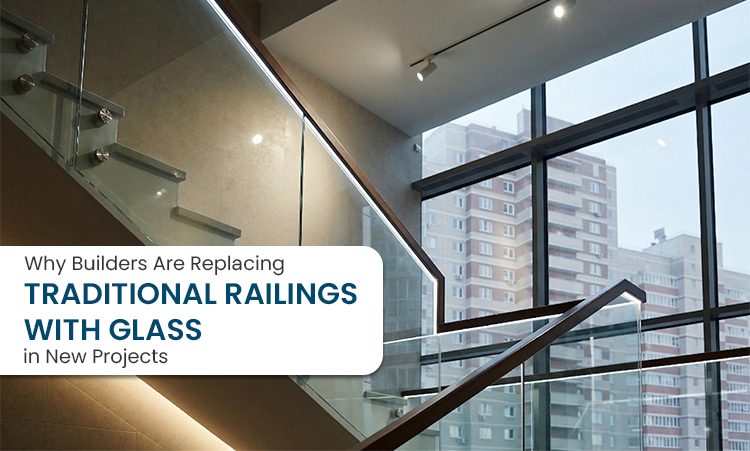
Why Builders Are Replacing Traditional Railings with Glass in New Projects
Walk into any new commercial building or modern apartment project and you’ll notice something changing. Railings don’t look the same anymore. Where steel bars or concrete sections were once standard, you now see glass. Staircases, balconies, terraces, even internal walkways are starting to use glass instead of traditional materials.
This isn’t happening just because it looks modern. Builders usually don’t change materials unless there is a practical reason behind it. And in this case, there are several.
Space Feels Different When Railings Don’t Block the View
One of the first things builders notice is how glass changes the feeling of a space. Traditional railings divide areas visually. Even when they are safe, they make spaces feel smaller or closed in. Glass does the opposite. It keeps the boundary but removes the visual barrier.
This usually matters for residential and commercial projects. Developers need a space to feel open without compromising on safety. Glass railings gives that balance.
Modern Buyers Expect Cleaner Design
Market expectations have changed. People investing in new apartments or commercial spaces today usually compare multiple properties. Design plays a role in those decisions. Clean lines, open spaces, and minimal visual clutter often influence buying choices.
Glass railings fit naturally into this type of design thinking. They look neutral. They don’t compete with interiors. They age better visually compared to some traditional railing styles. Builders notice this preference and adapt accordingly.
Safety Has Improved Compared to Older Glass Installations
Years ago, glass railings made some builders uncomfortable because they were associated with breakage risk. That perception has changed with toughened and laminated glass systems. Modern railing glass is designed to handle impact and remain stable even if damaged. Laminated configurations are especially valued because the interlayer helps hold the panel together instead of allowing it to collapse.
Because of these improvements, glass railings are now considered practical safety solutions rather than decorative risks. Architectural design platforms regularly document how glass is being used more widely as safety glass technology improves.
Maintenance Can Be Simpler Than Metal Railings
Traditional railings often need ongoing maintenance. Steel needs repainting. Iron may corrode. Coatings fade. Weld points sometimes weaken over time. All of this adds long-term maintenance responsibility. Glass railings are not maintenance-free, but they usually involve simpler upkeep. Cleaning and periodic inspection often replace heavy maintenance work. For builders and property managers, this reduces long-term effort.
Durability Matters in High-Use Areas
In commercial buildings especially, railings deal with constant contact. People lean, push, or use them for support. Materials must handle that repeated stress without loosening or deforming.
Properly specified toughened laminated glass systems can handle this kind of daily use when correctly installed. This makes them suitable for offices, malls, hospitals, and institutional buildings. Builders are less interested in materials that only look good. They prefer materials that continue performing after years of use.
Installation Methods Have Become More Reliable
Another reason for the shift is improved installation systems. Earlier glass railing work depended heavily on site improvisation. Today, better hardware systems and fabrication methods allow more predictable installation quality.
The edge finishing with better anchoring systems, and also tested mounting hardware have made glass railings easy to integrate into structural planning. As installation confidence improves, adoption naturally increases.
Builders Prefer Working With Reliable Glass Manufacturers
Material choice is rarely just about the material itself. Builders also look at who is supplying it. Consistency, fabrication accuracy, delivery timelines, and understanding project pressure all influence supplier decisions.
Glass used in railing systems must match specifications closely. Even small inconsistencies can affect installation. Because of this, many builders prefer working with manufacturers who understand construction realities rather than just selling glass as a commodity product.
How TUFFTRON Supports Modern Railing Requirements
At TUFFTRON, glass used for railing applications is treated as a structural safety component, not just a visual feature. Projects usually require consistency across panels, proper strength selection, and fabrication quality that supports smooth installation. Understanding where the glass will be used becomes part of the process. The focus stays on supplying toughened laminated glass suited for environments where reliability and safety cannot be taken lightly.
Closing Thought
Moving away from traditional to glass railings isn't about style as such over here. People tend to assume that. It rather shows how construction priorities are changing now in the present. Builders prefer materials that support modern design, reduce the usual maintenance issues, and perform reliably over a long period of time.
Also, glass railings are becoming common not because they are new as a concept, but because they meet the practical expectations builders have always had from long. And when materials meet design and performance both, adoption follows smoothly at scale.