
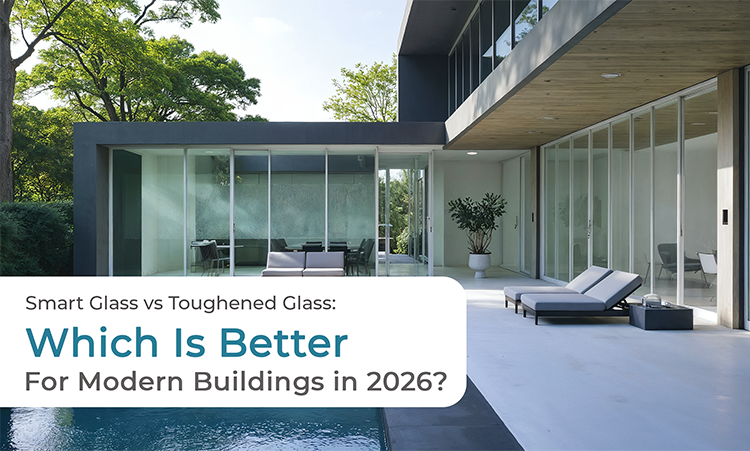
Smart Glass vs Toughened Glass: Which Is Better for Modern Buildings in 2026?
This question rarely comes up at the beginning of a project. At the start, most conversations are usually about design. How much glass should the building have? How open should the space feel? How much natural light should come inside? Then somebody asks a practical question. "What happens when privacy is needed?" That is often where the conversation changes. For years, the answer was simple. Use toughened glass and add blinds, curtains, or partitions wherever required. Today there is another option on the table. Smart glass. And that is why smart glass vs toughened glass has become a genuine discussion in modern projects instead of a technical comparison happening only between consultants.
Toughened Glass Became Popular for a Reason
Most people have already interacted with toughened glass without realising it. Office facades, shopfronts, railings, doors, and partitions. It became common because it solved a straightforward problem. People wanted glass that could handle everyday demands better than ordinary glass. Even today, when strength and safety are the main priorities, toughened glass remains one of the first materials considered in modern architectural glass projects. That is unlikely to change anytime soon.
Smart Glass Solves a Different Problem
The interesting thing about smart glass is that it was never created to replace toughened glass. It was created to solve a different challenge. Privacy, flexibility, and control. A meeting room can stay transparent most of the day and become private when needed. A cabin can feel open without permanently exposing everything inside. This ability is what attracts architects and business owners toward smart glass technology. Instead of adding another layer like blinds or curtains, the glass itself becomes part of the solution.
Why Offices Are Showing More Interest
Walk through a modern office today and you will notice something. Companies want open spaces. At the same time, they still need private spaces. That balance is harder than it sounds. Nobody wants rows of closed rooms. Nobody wants every conversation visible either. This is one reason smart office glass partitions have become more common over the last few years. They allow teams to switch between openness and privacy without permanently changing the space. For many businesses, that flexibility is the real attraction.
The Privacy Conversation Has Changed
A few years ago, privacy usually meant covering glass. Today, people are asking whether the glass itself can create privacy. That shift has increased interest in privacy glass and switchable glass solutions. The appeal is easy to understand. When privacy is no longer needed, the space immediately feels larger and more connected again. Instead of treating privacy as something added later, it becomes built into the design itself.
Energy Efficiency Is Becoming Part of Glass Selection
Building owners are paying closer attention to operating costs than they did before. As a result, glass is no longer being selected only for appearance. Questions around heat, daylight, glare, and comfort now appear much earlier in project discussions. Certain forms of electrochromic glass can respond to changing light conditions, which is why they often enter conversations around energy efficient glass solutions. For some projects, that benefit becomes more important than aesthetics alone.
So Which One Is Actually Better?
The honest answer is that neither is universally better. A hospital waiting area may need something different from a corporate boardroom. A retail showroom may have different priorities from a luxury residence. Smart glass for buildings makes sense when privacy, adaptability, and user experience are important considerations. Toughened glass makes sense when durability, safety, and straightforward performance are the primary requirements. The decision usually becomes easier once the purpose of the space is clear.
What Architects Are Noticing in Newer Projects
One trend appears repeatedly. Glass is being asked to do more than it did ten years ago. Earlier, glass mainly separated spaces. Today, it is expected to contribute to comfort, privacy, energy performance, and overall user experience. That shift is what's driving interest in intelligent glass solutions across commercial and premium residential projects now. Architecture related platforms that are covering global building trends have also highlighted the growing adoption of adaptive glass systems in modern developments lately.
How Tufftron Approaches These Conversations
At Tufftron, glass discussions usually begin with the project itself. Not every building needs the same answer. The right choice often depends on how the space will actually be used once construction is complete. A conference room has different requirements from a facade. A healthcare facility has different requirements from a luxury home. Understanding that difference helps project teams select solutions that make sense both on paper and in everyday use. You can explore more glazing solutions and industry insights through Tufftron.
Closing Thought
The most useful question is not whether smart glass or toughened glass is better. It is whether the glass helps the building function the way people expect it to. In some projects, strength and simplicity are exactly what is needed. In others, privacy, flexibility, and control become equally important. That is why both continue finding a place in modern buildings, even as construction priorities keep evolving.