
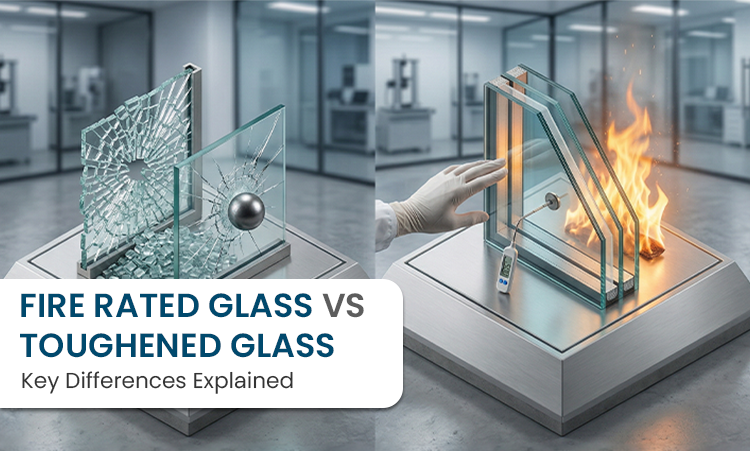
Fire-Rated Glass vs Toughened Glass: What Builders Usually Clarify Before Finalizing Materials
Glass decisions in commercial projects are rarely about looks alone anymore. Today glass becomes part of the safety discussion. Architects look at structural loads. Fire consultants look at evacuation safety. Contractors think about installation risks. Developers think about maintenance. And somewhere during approvals this question almost always comes up:
Should we use toughened glass here? Or is fire-rated glass required?
The confusion is understandable because both come under safety glass. But they exist for completely different reasons. Knowing where each one fits usually avoids redesign headaches later.
What Toughened Glass Is Actually Meant To Handle
Toughened glass is basically chosen for durability under physical stress. The glass is heat treated and then cooled rapidly during manufacturing. This process changes how stress distributes across the surface, making it far stronger than standard glass.
Because of this, it tolerates daily usage much better. Doors slamming. Public movement. Vibrations. Minor impacts. If it ever breaks, it usually turns into small blunt pieces instead of sharp shards. That is the main safety advantage.
You will normally see it used in everyday structural areas like office glass partitions, entrance doors, railings, stair panels and exterior glazing where strength matters more than anything else. Its job is simple. Stay strong during use. Reduce injury risk if failure happens. Fire resistance is not its role.
Where Fire Rated Glass Comes Into The Picture
Fire rated glass is selected when the discussion shifts from strength to containment. During a fire situation, the concern is how long a barrier can slow heat and smoke movement. That delay is what helps evacuation happen safely. This type of glass is tested for endurance under extreme temperatures rather than physical impact.
Depending on project requirements, ratings may vary based on how long the assembly can hold before failure under fire exposure. This is why it shows up in escape passages, protected staircases, electrical service rooms, fire separation walls and similar controlled safety zones. In these areas, regular toughened glass would simply not survive the heat conditions it was never designed for.
Why They Cannot Be Used Interchangeably
This is where mistakes sometimes happen. People hear "safety glass" and assume one strong glass can solve everything. But construction safety never works like that. Each material addresses a specific risk at hand. Toughened glass protects against breakage hazards during usage.
Fire glass buys time during emergencies. When drawings specify one and another is installed instead, it can create compliance problems later during inspections. That is why consultants usually insist on exact specification matching instead of substitutions.
What Design Teams Normally Look At Before Approving Glass
Approval decisions usually come down to practical questions. What risk are we solving here? Is this location part of fire escape routing? Will this area face heavy human interaction? Does the installation method affect safety?
Certification matters heavily for fire performance materials. Processing quality matters heavily for toughened applications. This is also why many project teams prefer working with processors they already trust instead of experimenting during execution stage. And most teams follow the guidelines as even showcased on NFPA. Consistency matters more than promises.
Why Processing Quality Quietly Decides Long Term Performance
Even when the right glass type is selected on paper, execution quality still makes a difference. Improper tempering can introduce internal stress variation. Rough finishing increases vulnerability near edges. Poor transport handling can damage specialised layers without visible signs. These are not things noticed on day one. They show up later.
Which is why many experienced contractors evaluate the processor capability as seriously as the specification itself. Because at building scale, reliability matters more than individual sheet performance.
How Tufftron Supports Commercial Project Requirements
Tufftron typically works with commercial projects that need dependable glass processing rather than just supply. Their involvement usually starts with understanding where the glass will actually be used instead of pushing catalog selections.
Projects often require toughened glass for partitions, railings, facade sections and structural glazing where consistency of finish and strength reliability matters during installation. Instead of forcing standard sizes everywhere, discussions usually revolve around application suitability and processing feasibility.
Closing Thought
Wrong glass choices rarely happen because teams lack knowledge. Most mistakes happen when materials that sound similar get treated as identical. They are not. Toughened glass helps buildings stay safe during everyday use. Fire rated glass helps buildings stay safe during worst-case situations.
When materials match their purpose, projects move smoothly. When they don't, corrections become expensive. And in construction, the safest decision is usually the one made correctly the first time.